
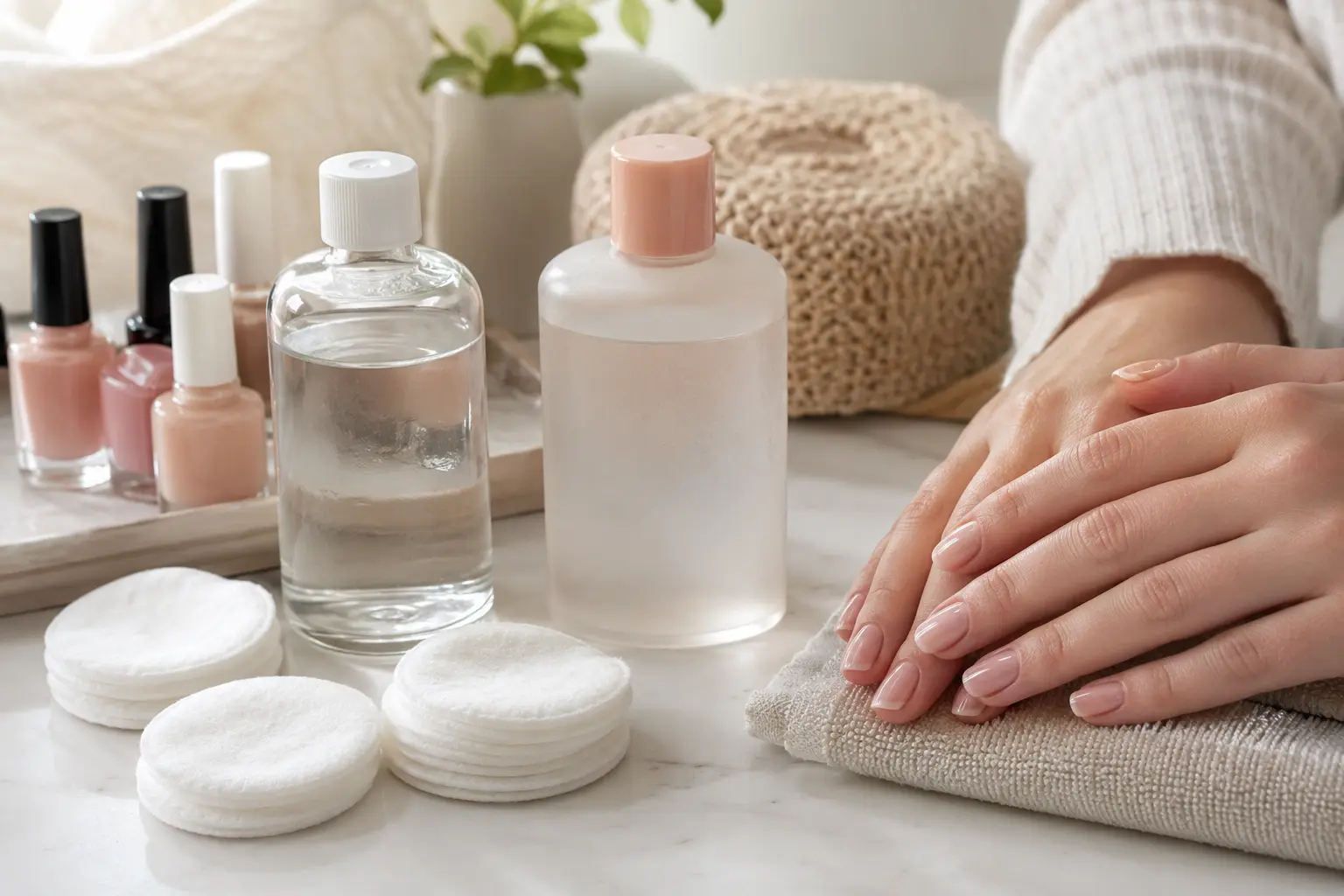

If you have ever stood in the nail-care aisle wondering about nail polish remover vs acetone, the difference is fairly simple.
Acetone is a powerful solvent, while nail polish remover is a finished product that may contain acetone or use other solvents instead.
For regular nail polish, a standard remover is usually enough. Pure acetone works faster and is better suited to stubborn products such as glitter polish, soak-off gel, dip powder, and some artificial nail enhancements.
Here is the quick answer:
| What you’re removing | Usually the better choice |
|---|---|
| Regular nail polish | Nail polish remover |
| Dark or glitter polish | Acetone or acetone-based remover |
| Soak-off gel polish | 100% acetone |
| Dip powder | 100% acetone |
| Acrylic nails | Usually acetone with careful filing |
| Regular polish on dry or brittle nails | Acetone-free remover |

The strongest option is not automatically the best one. What matters is choosing a remover that matches the type of manicure you have.
Is Acetone the Same as Nail Polish Remover?

No. They are related, but they are not the same thing.
Acetone is an ingredient. Nail polish remover is a product.
Acetone is a strong solvent that quickly breaks down many nail coatings. You can buy it as a highly concentrated solution, including products labeled 100% acetone.
Nail polish remover can contain several ingredients. Some formulas use acetone as the main solvent, while acetone-free removers rely on alternatives such as ethyl acetate or isopropyl alcohol.
Removers may also contain:
- Water
- Fragrance
- Oils
- Moisturizing ingredients
- Conditioning agents
So, two bottles labeled “nail polish remover” can work very differently.
If you specifically want to avoid acetone, look for acetone-free on the label and check the ingredient list.
Nail Polish Remover vs Acetone: Key Differences
Acetone
When comparing nail polish remover vs acetone, the biggest difference is how quickly they dissolve different types of nail products.
Acetone’s biggest advantage is speed.
It dissolves many nail products much faster than gentler removers, which makes it especially useful for gel, dip powder, glitter, and artificial nail products.
However, acetone can also remove oils from the nail plate and surrounding skin. After using it, your nails and cuticles may feel noticeably dry.
Nail Polish Remover
Regular nail polish remover is designed primarily for removing traditional nail color.
An acetone-based remover can still work quite quickly, while an acetone-free formula normally requires a little more patience.
For someone who changes regular polish frequently, a standard remover may be more practical than reaching for pure acetone every time.
Which Is Better for Regular Nail Polish?
For ordinary nail polish, regular nail polish remover is usually the better choice.
You rarely need 100% acetone for cream, sheer, jelly, or other conventional polishes.
For easier removal:
1. Saturate a cotton pad with remover.
2.Press it against the nail for a few seconds.
3.Wipe from the base of the nail toward the tip.
4.Repeat if necessary instead of aggressively scrubbing.
Letting the remover sit briefly gives the solvent time to soften the polish.
Pure acetone will usually remove regular polish faster, but that does not necessarily make it the best everyday choice.
If you frequently paint your natural nails, you may prefer an acetone-free or lower-acetone formula, particularly if your cuticles tend to feel dry.
Looking for your next manicure after removing your old polish? Our guide to simple nail designs includes easy ideas that work well on natural nails.
Is Acetone Better for Glitter Nail Polish?

Usually, yes.
Glitter polish can be surprisingly difficult to remove because glitter particles continue sticking to the nail even after much of the polish has dissolved.
Pure acetone or an acetone-based remover can make the process considerably easier.
Instead of scrubbing back and forth, soak a small cotton pad or cotton ball with remover and press it firmly against the nail for a short time. This allows the solvent to soften the polish before you wipe.
You may still need more than one pass, but the process should require less rubbing.
Do You Need Acetone to Remove Gel Nail Polish?
For soak-off gel polish, acetone is generally the most effective option.
The American Academy of Dermatology recommends 100% acetone as an at-home removal method for gel polish. It also recommends protecting the surrounding skin and limiting unnecessary acetone exposure.
A common gel-removal method involves:
- Lightly filing the shiny topcoat if the product instructions call for it.
- Applying petroleum jelly around the surrounding skin.
- Saturating cotton with acetone.
- Placing the cotton directly over the nail.
- Wrapping the fingertip to keep the cotton in place.
- Allowing the gel enough time to soften.
- Gently removing softened product without forcefully scraping.

One important detail is that not every product described as “gel” removes in the same way.
Gel polish, builder gel, soft gel extensions, and hard gel are different systems. Some soak off in acetone, while others may require professional filing.
If you are unsure which type you have, it is safer to ask your nail technician before trying to remove it yourself.
Don’t Peel Gel Polish Off
Once a gel manicure starts lifting around the edges, peeling it can feel very tempting.
Try not to.
Peeling the product away can also pull superficial layers from your natural nail, leaving the nail thinner and rougher.
Removing the coating properly takes longer, but it is generally much kinder to your natural nails.
What About Dip Powder?
Dip powder is another manicure where regular acetone-free remover usually will not be strong enough.
Dip systems form a hard coating over the nail. Removal commonly involves carefully reducing some of the top layer before soaking the remaining product in acetone.
If you are comparing manicure systems before your next appointment, our dip powder vs gel nails guide explains how the two compare in durability, application, removal, appearance, and nail care.
The removal process is worth considering before choosing dip purely because it lasts longer.
A manicure that lasts several weeks may sound convenient, but it still needs to come off properly at the end.
Can You Use Acetone to Remove Acrylic Nails?
Yes. Acetone is commonly used when removing acrylic nails.
However, removing acrylic is more involved than wiping away regular polish.
Acrylic is usually filed down first to reduce its thickness. Acetone can then soften the remaining material so it can be removed more gently.
Trying to lift, pry, or pull acrylic nails off can damage the natural nail underneath.
If your acrylic has started lifting, that does not mean it is ready to be peeled away.
If you’re deciding whether to stay with acrylics or try something different, read our full acrylic vs gel nails comparison. It explains how the two systems differ in appearance, strength, maintenance, flexibility, and removal.
Is Acetone Bad for Your Nails?
Calling acetone simply “bad for nails” is too simplistic.
Acetone is useful precisely because it is a strong solvent. The issue is that it can also dry the nail plate, cuticles, and surrounding skin.
The effects are more noticeable when:
- You soak nails frequently.
- Acetone sits on the surrounding skin for a long time.
- Your nails are already dry or brittle.
- You repeatedly remove and reapply long-wear manicures.
- You scrape the nail aggressively after soaking.
So the better question is not necessarily, “Is acetone bad?”
It is:
Do I actually need acetone for the product I’m removing?
For standard polish, probably not.
For soak-off gel or dip powder, using the correct solvent may actually be preferable to aggressively scraping away a coating that has not properly softened.
Acetone vs Acetone-Free Remover for Dry or Brittle Nails

If you are removing regular polish and your nails already feel dry, thin, flaky, or brittle, an acetone-free remover may be worth trying.
It will often take longer, particularly with:
- Dark colors
- Multiple coats
- Glitter
- Long-wear polish
But you do not necessarily need the strength of pure acetone for an ordinary manicure.
Technique matters too.
Constantly rubbing the same nail for several minutes is not particularly gentle. Press the remover against the polish first and allow the solvent to do some of the work.
After removing your manicure:
- Wash your hands.
- Apply hand cream.
- Massage cuticle oil around the nail.
- Give dry nails a little time before another intensive removal session.
Acetone-Free Does Not Mean Chemical-Free
This is an important distinction.
An acetone-free remover is not a remover without solvents.
It simply uses something other than acetone to dissolve your polish.
Common alternatives may include solvents such as ethyl acetate and isopropyl alcohol.
That means “acetone-free” should not automatically be interpreted as:
- Natural
- Chemical-free
- Completely non-drying
- Suitable for every nail product
The formula still needs ingredients capable of breaking down nail polish.
Choose your remover based on what you actually need to take off, rather than assuming acetone-free always means better.
Be Careful With Unfamiliar “Magic” Gel Removers
Be cautious with unfamiliar products marketed as instant, magic, or ultra-fast gel removers, particularly when the ingredient information is unclear.
In January 2026, the U.S. Food and Drug Administration warned that it had found methylene chloride in several cosmetic products marketed as gel nail polish removers. Methylene chloride is prohibited for use in cosmetics in the United States.
This does not mean every quick gel remover contains the ingredient.
It does mean that clearly labeled products from reputable sources are a better choice than an unknown formula promising unusually fast results.
For conventional soak-off gel, standard acetone-based removal remains a much more established method.
How to Make Acetone Removal Less Drying

Sometimes acetone really is the right tool.
When you need it, a few small changes can reduce unnecessary exposure.
Protect the Skin Around Your Nails
Before soaking gel polish, apply a thin layer of petroleum jelly around your cuticles and surrounding skin.
Keep Acetone on the Nail
Use appropriately sized pieces of cotton instead of soaking your entire fingertip when possible.
Give the Product Time to Soften
Do not assume the manicure is ready to come off simply because it has been soaking for a few minutes.
If the coating is still firmly attached, more soaking may be safer than more scraping.
Moisturize Afterwards
Wash your hands after removal and apply a moisturizer or cuticle oil.
Acetone removes oils very effectively, so replacing moisture afterward can make the skin around your nails feel much more comfortable.
Which One Should You Keep at Home?
For many people, keeping both nail polish remover and acetone is useful.
Think of them as two tools for different jobs.
Keep Regular Nail Polish Remover For:
- Everyday polish changes
- Natural-nail manicures
- Sheer polish
- Cream polish
- Frequent color changes
Keep 100% Acetone For:
- Soak-off gel
- Dip powder
- Stubborn glitter polish
- Some artificial nail products
- Situations where regular remover is not effective enough
This approach means you do not have to use the strongest solvent every time you decide to change your nail color.
If you’re ready for a clean, understated manicure after removing extensions or gel, you may also like our guide to soap nails, a glossy, natural-looking style that works beautifully on shorter nails.

Nail Polish Remover vs Acetone: The Final Verdict
Use regular nail polish remover for everyday polish and reach for acetone when the manicure genuinely requires stronger removal.
Understanding nail polish remover vs acetone makes it easier to choose the right remover for your manicure.
For standard nail color, an ordinary remover is usually enough. If dryness is a concern, an acetone-free formula can be a sensible option, although it may take slightly longer to work.
For soak-off gel, dip powder, stubborn glitter, and certain nail enhancements, 100% acetone is much more effective.
The biggest mistake is not choosing one product over the other. It is trying to rush removal by peeling, scraping, or pulling a manicure off before it has properly softened.
At MorningFable, we want nail care to feel easier to understand, whether you’re comparing manicure types, figuring out how to remove them, or simply looking for your next nail idea. You can explore more practical guides including our acrylic vs gel nails comparison, dip powder vs gel nails guide, and more nail inspiration across MorningFable.com.
Frequently Asked Questions
Sources and Further Reading
- American Academy of Dermatology: guidance on removing gel manicures and caring for nails after gel or dip powder.
- U.S. Food and Drug Administration: information about nail-care products and its 2026 warning concerning methylene chloride in certain gel nail removers.
- Cosmetics Info: information about ingredients commonly used in nail polish and nail polish removers.


Pingback: Is Gel or Acrylic Better for Weak Nails? A Clear Guide
Pingback: Can You Get Your Nails Done While Pregnant?